
Note
Go to the end to download the full example code.
Stationary Dipole Fields#
This example visualizes the electromagnetic potentials and fields produced by a stationary electric dipole. The dipole consists of two opposite charges separated by a small distance, oriented along the y-axis. We calculate and plot the scalar potential, vector potential, electric field, and magnetic field in the x-y plane.
Import necessary libraries#
import jax
import jax.numpy as jnp
import matplotlib.pyplot as plt
import numpy as np
from matplotlib import colors
from scipy.constants import e

from pycharge import Charge, potentials_and_fields

jax.config.update("jax_enable_x64", True)
Define the stationary dipole#
A dipole consists of two charges with equal magnitude but opposite sign, separated by a small distance. We place it at the origin, oriented along the y-axis.
dipole_separation = 1e-10  # 0.1 nm
charge_magnitude = e  # Elementary charge (1.6e-19 C)


def positive_charge_position(t):
    """Position of the positive charge."""
    return (0.0, dipole_separation / 2, 0.0)


def negative_charge_position(t):
    """Position of the negative charge."""
    return (0.0, -dipole_separation / 2, 0.0)


charges = [
    Charge(position_fn=positive_charge_position, q=charge_magnitude),
    Charge(position_fn=negative_charge_position, q=-charge_magnitude),
]
Set up the observation grid#
Create a 2D grid in the x-y plane to visualize the fields.
grid_res = 300
grid_extent = 1e-9  # ±1 nm

x = jnp.linspace(-grid_extent, grid_extent, grid_res)
y = jnp.linspace(-grid_extent, grid_extent, grid_res)
z = jnp.array([0.0])
t = jnp.array([0.0])

X, Y, Z, T = jnp.meshgrid(x, y, z, t, indexing="ij")
Calculate electromagnetic quantities#
Compute all potentials and fields at once using a JIT-compiled function.
calculate_fields = jax.jit(potentials_and_fields(charges))
result = calculate_fields(X, Y, Z, T)

# Extract field components
scalar_potential = result.scalar.squeeze()
electric_field = result.electric.squeeze()
vector_potential = result.vector.squeeze()
magnetic_field = result.magnetic.squeeze()

extent = (float(x[0]), float(x[-1]), float(y[0]), float(y[-1]))
Plotting utilities#
def _sym_log_norm(data):
    """Symmetric logarithmic normalization."""
    vmax = float(jnp.max(jnp.abs(data)))
    return None if vmax == 0 else colors.SymLogNorm(linthresh=vmax * 1e-5, linscale=1, vmin=-vmax, vmax=vmax)


def _setup_axis(ax, title, xlabel="x (m)", ylabel="y (m)", grid_color="gray"):
    """Configure axis with labels, title, and grid lines."""
    ax.set_xlabel(xlabel)
    ax.set_ylabel(ylabel)
    ax.set_title(title)


def plot_field_2d(data, title, cbar_label, cmap="RdBu_r", norm=None):
    """Plot a 2D scalar field."""
    fig, ax = plt.subplots(figsize=(8, 6))
    norm = norm or _sym_log_norm(data)
    im = ax.imshow(data.T, origin="lower", cmap=cmap, norm=norm, extent=extent)
    fig.colorbar(im, ax=ax, label=cbar_label)
    _setup_axis(ax, title, grid_color="gray" if cmap == "RdBu_r" else "white")
    fig.tight_layout()
    plt.show()


def plot_vector_components(vector_data, title_prefix, cbar_label_prefix):
    """Plot x, y, z components of a vector field."""
    fig, axes = plt.subplots(1, 3, figsize=(15, 4))

    for idx, (ax, comp) in enumerate(zip(axes, ["x", "y", "z"])):
        data = vector_data[:, :, idx].T
        im = ax.imshow(data, origin="lower", cmap="RdBu_r", norm=_sym_log_norm(data), extent=extent)
        fig.colorbar(im, ax=ax, label=f"${cbar_label_prefix}_{{{comp}}}$")
        _setup_axis(ax, f"{title_prefix}: {comp.upper()}-component")

    fig.tight_layout()
    plt.show()


def plot_field(vector_field, title, cbar_label, streamlines=False, skip=10):
    """Plot field magnitude with optional streamlines."""
    magnitude = jnp.linalg.norm(vector_field, axis=-1)

    # Downsample for streamlines
    X_stream = np.array(X[::skip, ::skip, :, :].squeeze())
    Y_stream = np.array(Y[::skip, ::skip, :, :].squeeze())
    Fx_stream = np.array(vector_field[::skip, ::skip, 0])
    Fy_stream = np.array(vector_field[::skip, ::skip, 1])

    fig, ax = plt.subplots(figsize=(8, 6))

    # Background: magnitude
    vmin = float(jnp.min(magnitude[magnitude > 0])) if jnp.any(magnitude > 0) else 1e-30
    im = ax.imshow(
        magnitude.T,
        origin="lower",
        cmap="viridis",
        norm=colors.LogNorm(vmin=vmin),
        extent=extent,
    )

    # Foreground: streamlines (only if requested and field is non-zero)
    if streamlines and jnp.max(jnp.abs(vector_field)) > 0:
        ax.streamplot(
            X_stream.T,
            Y_stream.T,
            Fx_stream.T,
            Fy_stream.T,
            color="black",
            density=1.5,
            linewidth=0.8,
            arrowsize=1.0,
        )

    fig.colorbar(im, ax=ax, label=cbar_label)
    _setup_axis(ax, title, grid_color="white")
    ax.set_xlim(extent[0], extent[1])
    ax.set_ylim(extent[2], extent[3])
    fig.tight_layout()
    plt.show()
Scalar potential#
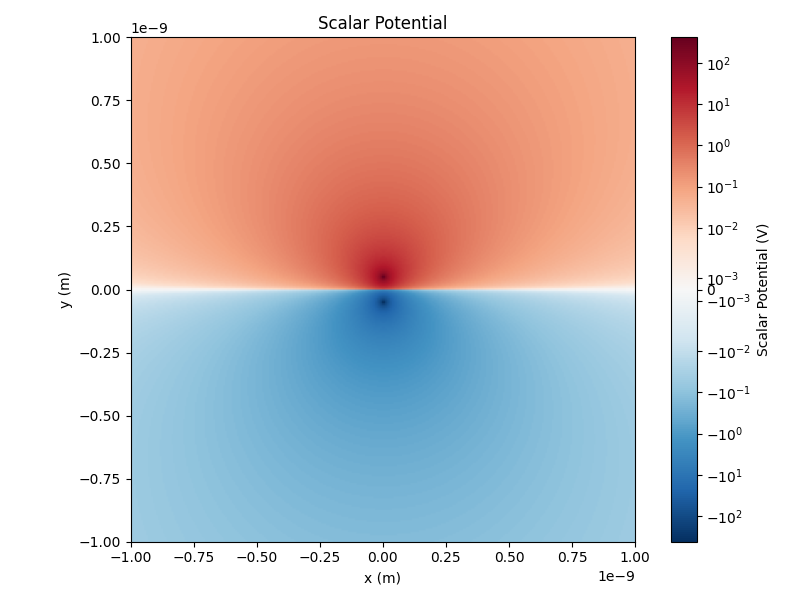
The scalar potential \(\phi\) exhibits the characteristic dipole pattern, with distinct positive and negative regions near each charge.
plot_field_2d(scalar_potential, title="Scalar Potential", cbar_label="Scalar Potential (V)", cmap="RdBu_r")
Vector potential#
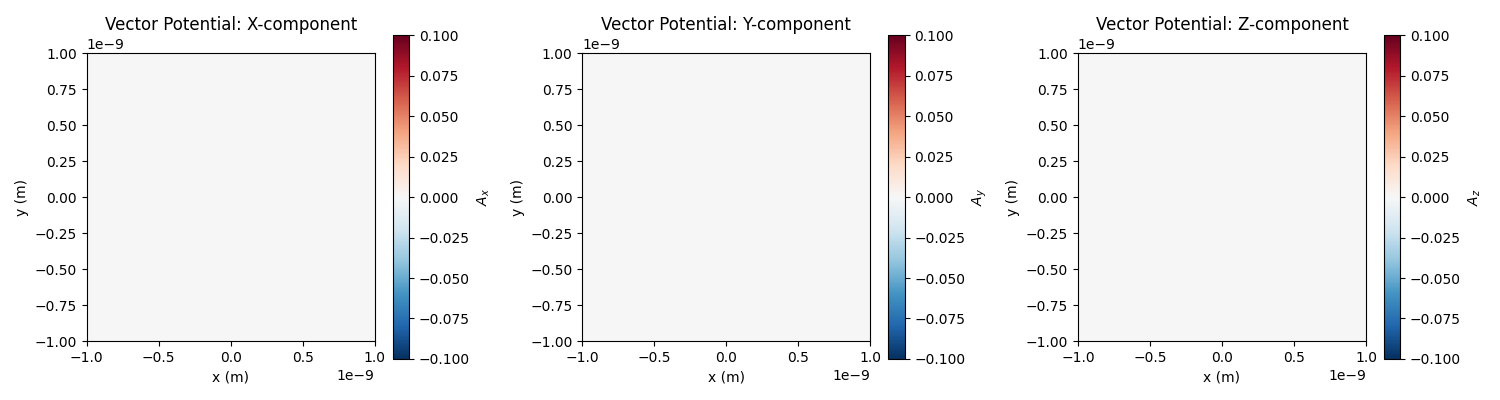
The vector potential \(\mathbf{A}\) is proportional to charge velocity. For stationary charges (\(\mathbf{v} = 0\)), the Liénard-Wiechert formulation gives \(\mathbf{A} \propto \mathbf{v} = 0\) everywhere.
plot_vector_components(vector_potential, title_prefix="Vector Potential", cbar_label_prefix="A")
Electric field#
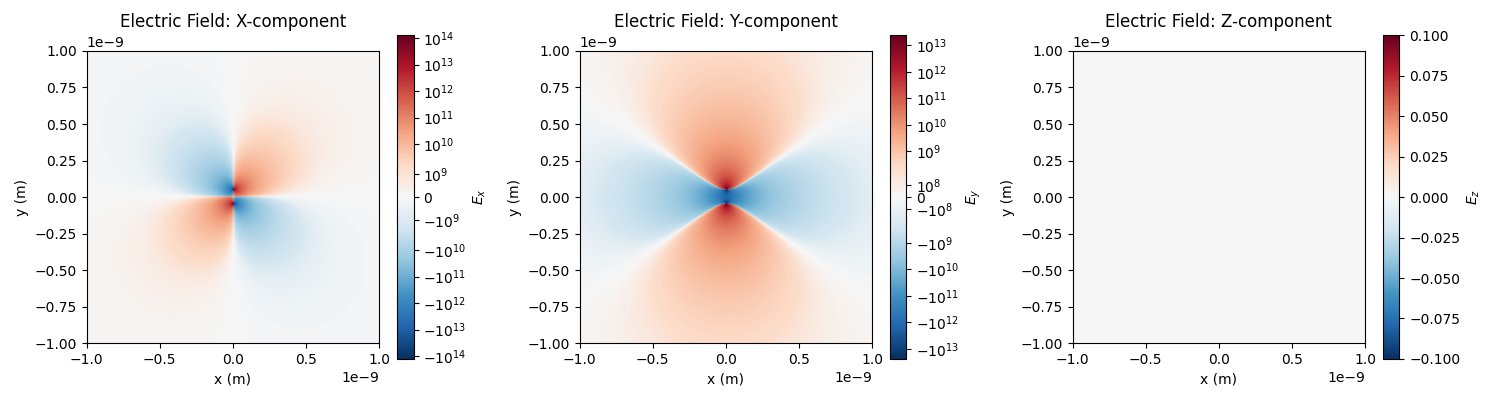
The electric field \(\mathbf{E} = -\nabla \phi - \partial \mathbf{A}/\partial t\) can be decomposed into x, y, and z components.
plot_vector_components(electric_field, title_prefix="Electric Field", cbar_label_prefix="E")
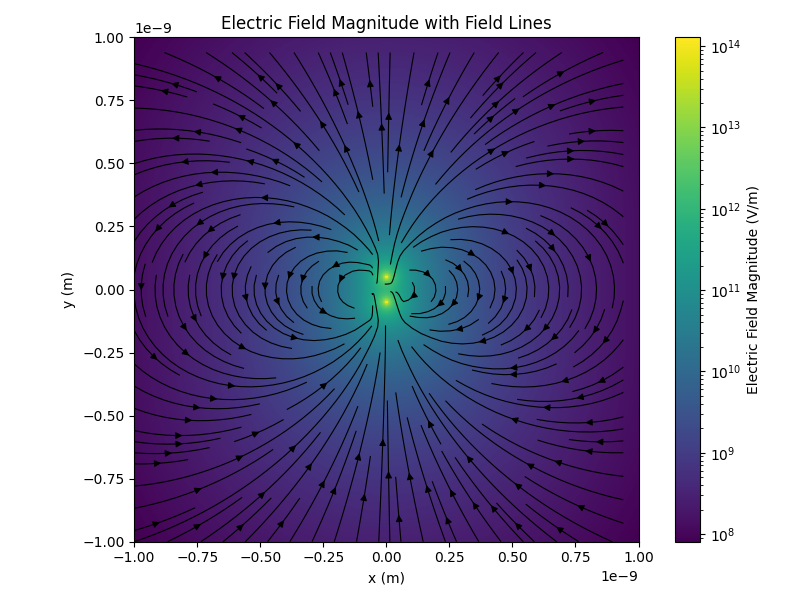
The field magnitude is strongest near the charges and decreases with distance. Streamlines emerge from the positive charge and terminate at the negative charge.
plot_field(
    electric_field,
    title="Electric Field Magnitude with Field Lines",
    cbar_label="Electric Field Magnitude (V/m)",
    streamlines=True,
)
Magnetic field#
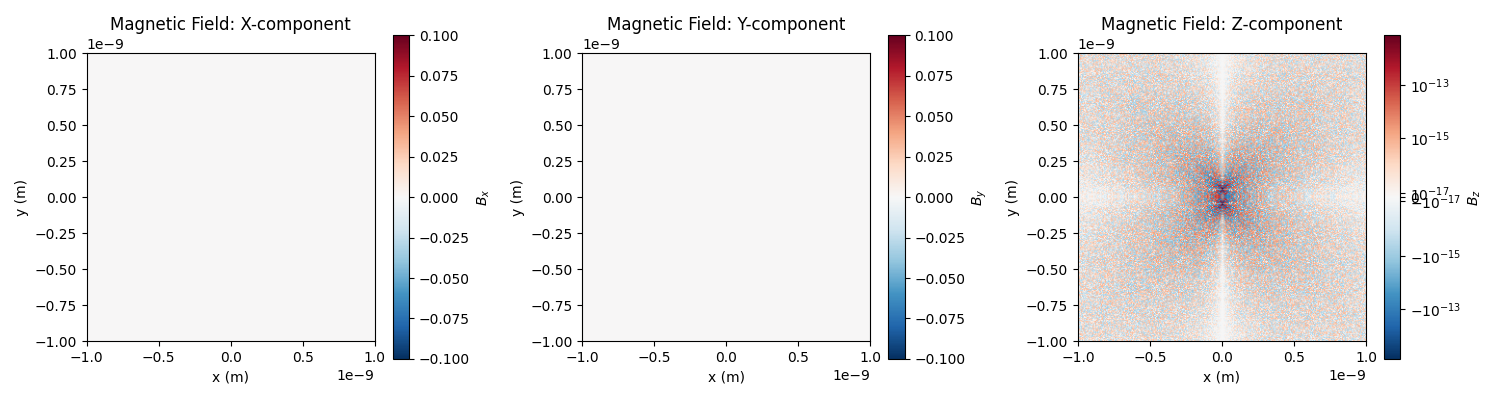
The magnetic field \(\mathbf{B}\) is generated by moving charges (currents). Since our charges are stationary (\(\mathbf{v} = 0\)), no current exists, and thus \(\mathbf{B} = 0\) everywhere.
Note that due to numerical precision limits in the PyCharge calculations, very small non-zero values appear in the z-component of the magnetic field below.
plot_vector_components(magnetic_field, title_prefix="Magnetic Field", cbar_label_prefix="B")
Total running time of the script: (0 minutes 4.484 seconds)